Table of Contents
ToggleChicago’s street cleaning program sweeps through neighborhoods April through November, and if your car’s parked on the wrong day, you’re looking at a $60 ticket, or worse, a tow. The city posts temporary “No Parking” signs 24 hours before cleaning, but catching them in time requires planning. Thousands of Chicago homeowners get caught each year, not because they ignored the rules, but because they didn’t know their schedule or misread the signage. This guide walks through exactly how Chicago’s cleaning program works, how to find your specific schedule, and what steps to take to keep your vehicles (and your wallet) safe.
Key Takeaways
- Chicago’s street cleaning schedule runs April through November with a $60 ticket or tow for parking violations, making it essential to check your cleaning zone and move vehicles beforehand.
- Use the City of Chicago’s online address-based lookup tool, ward-by-ward PDF maps, or the Chi311 app to find your specific street cleaning schedule and upcoming sweep dates in real time.
- Each cleaning zone is swept approximately once per month on a rotating schedule, typically during three-hour daytime windows on weekdays, with temporary ‘No Parking’ signs posted 24 hours in advance.
- Move your vehicle off the street before the posted time window begins by parking in your driveway, garage, alley, or a nearby unscheduled street to avoid citations and towing fees.
- Set up monthly calendar reminders for your zone’s recurring cleaning day, verify signage the evening before, and communicate schedules clearly with household members and guests to stay compliant.
Understanding Chicago’s Street Cleaning Program
The Chicago Department of Streets and Sanitation runs a mechanical street sweeping program from April 1 through November 30 each year. The program targets curb-to-curb cleaning on residential and arterial streets to remove winter debris, sand, salt residue, and accumulated litter.
The city divides Chicago into cleaning zones, and each zone gets swept on a rotating schedule, typically once per month during the active season. Streets don’t get cleaned on the same day citywide: instead, crews move systematically through neighborhoods based on a ward-by-ward calendar.
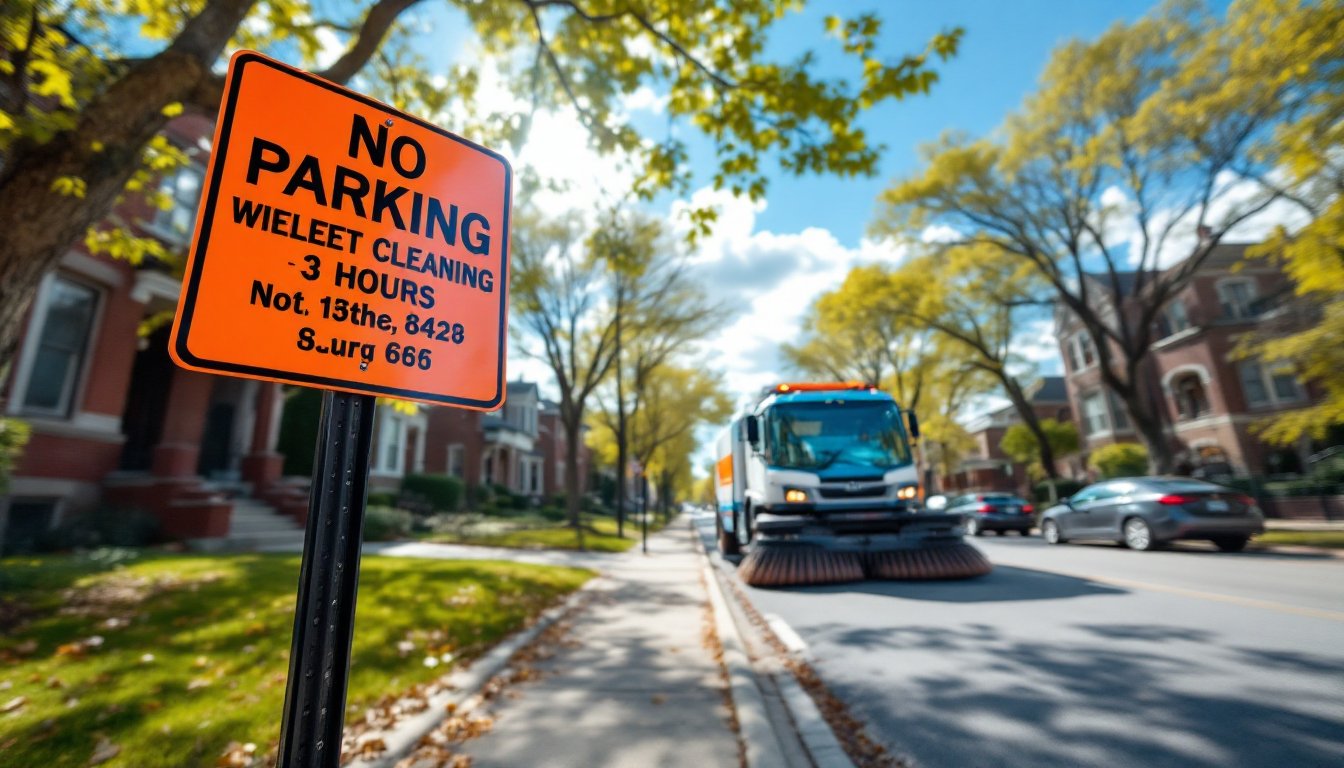
Temporary “No Parking” signs go up 24 hours before cleaning. These bright orange signs show the date and time window when parking is prohibited, usually a three-hour block during daytime hours. If your vehicle is parked during the posted window, it’s subject to a $60 ticket and possible tow.
The program is weather-dependent. If it rains heavily or equipment breaks down, cleaning may be postponed to the next business day. The city doesn’t send individual notifications for delays, homeowners need to watch for updated signage or check online.
This isn’t a structural or safety issue requiring permits, but ignoring the schedule has real financial consequences. The program funds itself partly through citations, so enforcement is consistent.
How to Find Your Street Cleaning Schedule
Chicago provides multiple ways to locate your street cleaning dates, but the most reliable method is the city’s online lookup tool.
Using the City’s Online Tools and Maps
The City of Chicago’s Street Sweeping Schedule page (accessible via the city’s .gov website) offers an address-based lookup. Enter your street address, and the system returns your cleaning zone and upcoming sweep dates for the season. The tool updates in real time if schedules shift due to weather.
For a broader view, the city publishes a ward-by-ward PDF map each spring showing zone boundaries and monthly cleaning calendars. Download the map for your ward and mark the dates on a calendar, most zones follow a predictable pattern year to year.
The Chi311 mobile app also includes street sweeping lookup. Input your address, and the app displays your next scheduled cleaning date along with reminders. You can enable push notifications, though homeowners should still verify signage in person since dates occasionally shift.
If you prefer analog methods, call 311 (or 312-744-5000 from outside Chicago) and provide your address. The operator will confirm your zone and next cleaning date.
Many cleaning schedules and local ordinances vary by municipality, so always cross-check with official city sources rather than third-party apps. Chicago’s system is specific to its zones and doesn’t align with suburban schedules.
When Does Street Cleaning Happen in Chicago?
Street cleaning runs April 1 through November 30 annually. The city doesn’t sweep in winter months, December through March, due to snow, ice, and road salt application.
Within the active season, each zone gets cleaned approximately once per month. A typical North Side neighborhood might see sweeping on the second Tuesday of each month, while a South Side zone could be scheduled for the third Thursday. The pattern holds unless weather or equipment issues cause delays.
Cleaning windows are usually three-hour blocks between 8:00 AM and 4:00 PM on weekdays. The exact time appears on the temporary signs posted 24 hours in advance. Streets are rarely swept on weekends or city holidays.
Arterial streets and high-traffic corridors may get cleaned more frequently, sometimes twice per month, since they accumulate debris faster. Residential side streets stick to the monthly rotation.
If a scheduled cleaning falls on a holiday, it’s typically moved to the next business day. The city posts updated signage reflecting the new date, but homeowners should verify online if they notice a holiday conflict.
Weather postponements are common in spring. If it’s raining hard enough to make sweeping ineffective, crews skip that street and reschedule. The city doesn’t send alerts, you’ll see fresh signage indicating the rescheduled date.
What to Do on Your Street Cleaning Day
The most important step: move your vehicle off the street before the posted time window begins. Park in your driveway, garage, or alley if available. If not, relocate to a nearby street that isn’t scheduled for cleaning that day.
Check the temporary signs carefully. They show the exact date and time range when parking is prohibited. Some homeowners assume the ban starts at noon, but many zones begin at 8:00 AM or 9:00 AM. Arriving home at 10:00 AM to find a ticket is a common mistake.
If you don’t have off-street parking and neighboring streets are also being cleaned, look one or two blocks away. The city staggers schedules so adjacent blocks rarely sweep on the same day. Alternatively, park in a commercial lot for the morning, it’s cheaper than a $60 ticket.
Don’t rely on “I’ll just move it if I see the truck coming.” Enforcement officers often ticket ahead of the sweeper. By the time the truck arrives, citations have already been issued.
If you’re a multi-car household, plan logistics the night before. Shuffling vehicles at 7:00 AM is easier than doing it in a rush. Discuss with household members so everyone knows which cars need to move.
For homeowners with guests or tenants, communicate the schedule clearly. Leave a note, send a text, or post a reminder on a shared calendar. Visitors unfamiliar with Chicago’s system are frequent offenders.
If you physically can’t move your car due to disability or medical emergency, contact the city before the sweep to request an exemption. The process isn’t guaranteed, but it’s better than appealing a ticket after the fact.
Tips for Homeowners to Stay Compliant and Avoid Fines
Set up recurring calendar reminders based on your zone’s schedule. Most zones follow the same day each month (e.g., the second Wednesday), so a monthly repeating alert on your phone or email keeps it top of mind.
Walk your block the evening before your scheduled cleaning day. Verify that temporary signs are posted. If you don’t see signage by 24 hours before the scheduled sweep, the city may have postponed due to weather. Double-check online or call 311 to confirm.
Subscribe to the city’s street sweeping email list if available, or enable notifications through the Chi311 app. While not foolproof, these tools provide advance notice and delay alerts.
If you’re going out of town during your cleaning window, arrange for someone to move your car or park it off-street before you leave. Towing adds impound fees and retrieval headaches on top of the citation.
Keep a printed or digital copy of your zone’s annual schedule in your vehicle or wallet. When planning appointments or errands, cross-check the date so you’re not caught off guard.
For homeowners who regularly park on the street, consider investing in a driveway apron or alley access if your property allows it. This requires a city permit (contact the Department of Transportation for residential driveway permits), but it eliminates street cleaning conflicts entirely. Apron installation is a concrete or asphalt job best handled by a licensed contractor, and costs vary widely depending on site prep and drainage.
If you receive a ticket and believe it was issued in error, such as signage posted late or your car already moved, document everything. Take timestamped photos of your parking spot, the signs, and surrounding streets. Contest the ticket through the city’s online portal within 21 days. Appeals succeed most often when you have clear evidence the city didn’t follow its own posting requirements.
Many urban living challenges and logistics share common threads, but Chicago’s enforcement is notably strict compared to other cities. Don’t assume leniency.
Finally, talk to neighbors. Many blocks have informal group chats or Nextdoor threads where residents remind each other the night before sweeping. A little community coordination goes a long way toward keeping the whole block ticket-free.
Conclusion
Chicago’s street cleaning program is straightforward once you know your zone and schedule. Mark the dates, set reminders, and move your car before the posted window. The temporary signs give 24 hours’ notice, and the city’s online tools make lookups easy. For additional home management tips and seasonal guides, staying organized with municipal schedules is just one piece of responsible homeownership. A little planning each month keeps your vehicle safe and your budget intact.