Table of Contents
ToggleAuckland’s unpredictable weather, heavy rain one day, dry spells the next, puts serious demands on your home’s drainage system. Clogged gutters don’t just overflow: they cause rot, foundation cracks, and pest infestations that cost thousands to repair. Whether you’re tackling the job yourself or hiring it out, understanding gutter maintenance in Auckland’s coastal climate is essential for protecting your investment. This guide covers when to clean, how to do it safely, what professionals charge in 2026, and how to keep your gutters flowing between cleanings.
Key Takeaways
- Gutter cleaning in Auckland should be scheduled twice yearly (April-May and November-December) due to the subtropical climate’s year-round debris from native trees like pohutukawa, plus Auckland’s 1,200mm annual rainfall concentrated in winter months.
- Neglected gutters cause costly damage including foundation cracks, wood rot costing $800+, pest infestations, and potential insurance claim disputes if blockages lead to water damage during storms.
- DIY gutter cleaning is safe for single-story homes with proper equipment and a spotter, but two-story homes or steep roofs should use professional services—expect $120-$200 for basic cleaning, or $200-$350 for complex properties in 2026.
- Gutter guards reduce cleaning frequency from twice yearly to annually but require investment of $8-$35 per meter installed; mesh screens are most effective though fine debris like pine needles may still clog them.
- Professional contractors should carry $1-2 million public liability insurance and provide written quotes specifying debris removal, downspout flushing, and inspection services—avoid rock-bottom prices as they often indicate rushed work or safety shortcuts.
- Between professional gutter cleaning appointments, trim tree branches 1.5 meters back from your roofline, inspect after storms, check gutter pitch for sagging, and monitor downspout outlets during rain to catch developing blockages early.
Why Regular Gutter Cleaning Is Essential for Auckland Homes
Auckland’s subtropical climate brings over 1,200 mm of rain annually, concentrated in winter months. When gutters fill with leaves, moss, and debris, water overflows instead of channeling away from your home’s foundation.
The consequences go beyond cosmetic annoyance. Water pooling near your foundation can seep into basements or crawl spaces, causing structural damage and mold growth. Overflowing gutters also saturate fascia boards, leading to wood rot that requires replacing entire sections of trim, a job that starts around $800 before you even address the underlying damage.
Auckland’s coastal environment accelerates corrosion in metal gutters, and standing water speeds up that process. Regular cleaning removes the acidic organic matter that eats through galvanized steel and aluminum. Native trees like pohutukawa and puriri drop thick foliage year-round, not just in autumn, so Auckland homeowners face debris accumulation in every season.
Neglected gutters become nesting sites for rats, possums, and wasps. These pests don’t just occupy the gutters, they use them as access points to your roof cavity and wall voids. Mosquitoes breed in stagnant water trapped by blockages, creating health hazards during warmer months.
Insurers increasingly scrutinize maintenance records after weather events. If a blocked gutter causes water damage during a storm, you may face coverage disputes if you can’t demonstrate regular upkeep. Most policies expect reasonable preventive maintenance, and gutter cleaning sits firmly in that category.
When to Schedule Gutter Cleaning in Auckland’s Climate
The standard advice is twice yearly, but Auckland’s weather patterns demand a more tailored approach. Schedule your first cleaning in late autumn (April-May), after deciduous trees shed their leaves but before winter rains begin in earnest.
The second cleaning should happen in late spring (November-December), clearing out pohutukawa flowers, seed pods, and accumulated grime before summer storms hit. If your property has large trees overhanging the roofline, add a third cleaning in mid-winter.
Watch for warning signs between scheduled cleanings. Water spilling over gutter edges during rain means immediate attention is needed. Check downspouts after heavy rain, if water isn’t flowing freely from the outlet, you’ve got a blockage forming.
Sagging gutters or visible plant growth signal serious neglect. Seedlings sprouting from your gutters mean organic matter has been sitting long enough to create soil conditions. At that point, you’re not just dealing with debris removal but potential bracket damage from the added weight.
Timing matters for safety, too. Auckland’s winter brings unpredictable rain squalls that make ladder work dangerous. Schedule cleanings during settled weather periods, and avoid working on gutters within 24 hours of rain, wet leaves are heavier and slipperier than dry debris.
DIY Gutter Cleaning: Tools and Safety Tips for Homeowners
Single-story homes with accessible rooflines are manageable DIY projects if you’re comfortable on ladders. Two-story homes or steep-pitch roofs should go to professionals, the risk isn’t worth the savings.
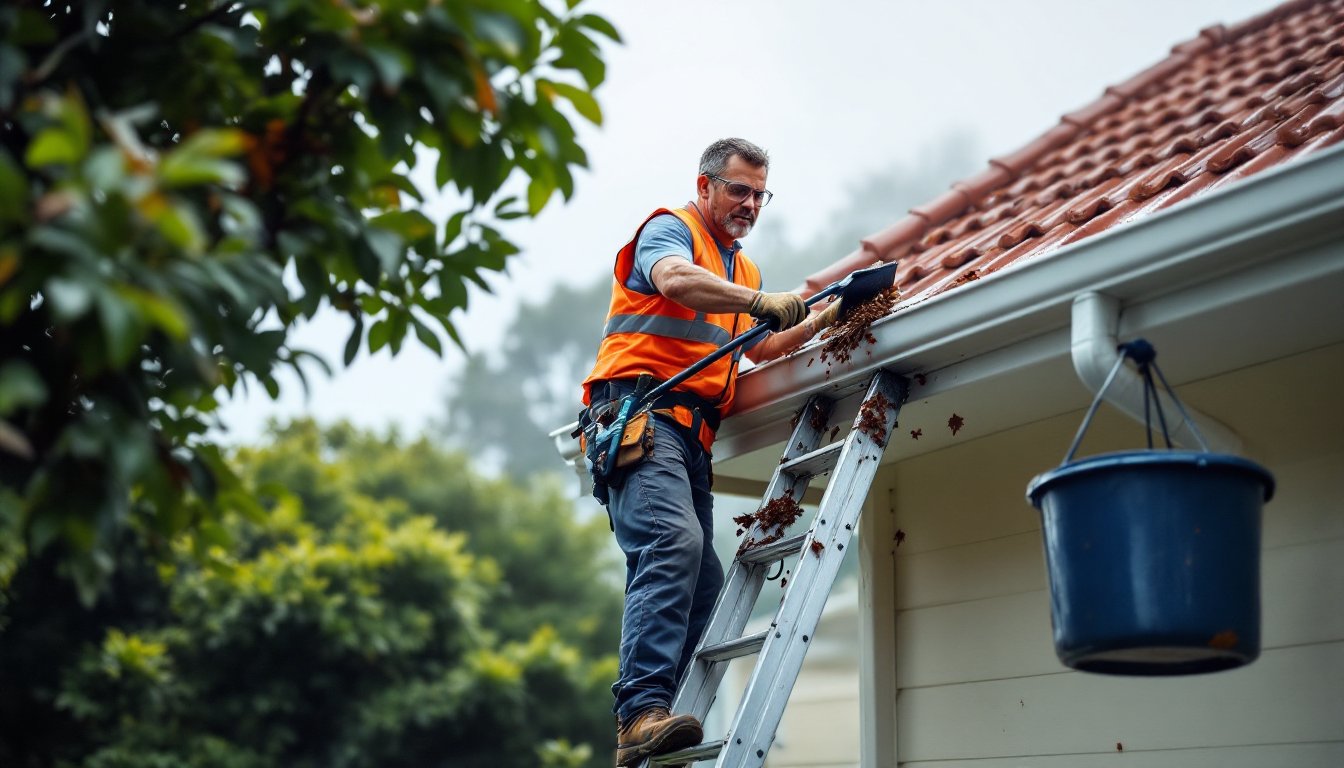
Safety comes first. Never work alone on ladders. Have someone foot the ladder and hand you tools. Wear non-slip rubber-soled boots, not sandals or smooth-soled shoes. Safety glasses are non-negotiable, decomposing organic matter can harbor bacteria and mold spores.
Set your ladder on firm, level ground. An A-frame ladder works for low sections, but you’ll need an extension ladder for most residential gutters. Position it so the base sits one meter out for every four meters of height. Ladder stabilizers prevent the top from damaging gutters or slipping sideways.
Work in three-meter sections. Overreaching causes falls, move the ladder instead. Never stand on the top two rungs.
Essential Equipment You’ll Need
Start with the basics before investing in specialty tools:
• Gutter scoop or a plastic garden trowel (metal tools scratch gutter linings)
• Heavy-duty work gloves, leather or rubberized, not fabric garden gloves that soak through
• Bucket with a hook to hang from the ladder, keeping both hands free
• Garden hose with a spray nozzle, pressure washers are overkill and can damage gutter seams
• Plumber’s snake (about 5 meters) for clearing downspout blockages
• Drop cloths to protect landscaping and collect debris
A gutter cleaning wand attachment for your hose lets you flush from ground level after removing bulk debris, useful for final rinse work. Telescoping gutter tools exist, but they’re awkward for anything beyond light maintenance.
For homes surrounded by trees, consider a wet/dry shop vacuum with a gutter attachment. These tools handle wet leaves better than manual scooping, though you’ll still need to bag the slurry afterward.
Start at the downspout and work away from it, pushing debris ahead of you. This prevents pushing material into the downspout opening, which causes the worst blockages. After removing bulk debris, flush gutters with your hose, checking that water flows freely to downspouts and exits cleanly at ground level.
If water pools instead of flowing, your gutters may have incorrect pitch (should slope 1 cm per 3 meters toward downspouts). That’s a bigger job requiring bracket adjustment or replacement.
How to Choose Professional Gutter Cleaning Services in Auckland
Hiring out makes sense for multi-story homes, properties with steep roofs, or homeowners who aren’t comfortable with ladder work. Auckland has dozens of gutter cleaning services, but quality varies significantly.
Start by checking public liability insurance. A legitimate contractor carries at least $1-2 million in coverage. Ask for proof, a reputable company provides it without hesitation. Insurance protects you if a worker is injured on your property or causes damage during the job.
Get three written quotes for comparison. Be wary of rock-bottom prices, they usually mean corner-cutting on safety or rushed work. The quote should specify what’s included: debris removal, downspout flushing, disposal, and basic gutter inspection.
Ask about disposal fees. Some companies include this, others charge extra for hauling away debris. Clarify whether they’ll bag and remove material or simply dump it on your lawn for you to handle.
Check online reviews, but read critically. Platforms like Angi provide verified customer feedback that helps identify consistent service patterns. Look for comments about punctuality, thoroughness, and how companies handle problems.
Request references from recent jobs, especially properties similar to yours in size and tree coverage. A company that excels at simple single-story cleanings may struggle with complex rooflines or heavy debris loads.
Professionals should inspect while they work, noting rust spots, loose brackets, separated seams, or damaged downspouts. A good contractor alerts you to problems before they become emergencies. Be suspicious of companies that find expensive “urgent” repairs during every visit, that’s often upselling rather than genuine concern.
Ask what equipment they use. Vacuum systems are more thorough than manual removal and contain dust and allergens. Pressure washing sounds effective but can force water under shingles or damage gutter seals if done incorrectly.
Seasonal availability matters. Book your autumn and spring cleanings weeks in advance, good contractors fill their schedules early during peak seasons.
Cost of Gutter Cleaning in Auckland: What to Expect in 2026
Pricing in Auckland varies by home size, gutter length, debris levels, and accessibility. As of 2026, expect these ballpark figures, though regional differences and market conditions affect actual quotes.
Single-story homes with standard gutter lengths (around 30-40 meters) typically run $120-$200 for a basic cleaning. That includes debris removal, downspout flushing, and hauling away the waste.
Two-story homes or properties with complex rooflines jump to $200-$350, reflecting the additional time, equipment, and safety requirements for working at height.
Heavy debris loads add $50-$100 to the base price. If your gutters haven’t been cleaned in years and contain compacted material or seedlings, expect surcharges. Some companies charge extra for homes with tile roofs, which require special care to prevent breaking tiles while accessing gutters.
Downspout augering (clearing blockages deep in the downspout system) may cost $30-$60 per downspout beyond the basic flush included in standard cleaning.
Many contractors offer maintenance contracts for 2-3 cleanings per year at discounted rates, typically 10-15% off the per-visit price. These make sense if you have mature trees and need frequent service.
According to HomeAdvisor, gutter repairs identified during cleaning, like resealing joints or replacing brackets, run $15-$25 per linear meter for minor fixes. Major sections requiring replacement start around $35-$50 per meter for aluminum gutters.
Always clarify whether quotes include GST (they should) and if there are travel fees for properties outside the main Auckland metro area. Some rural or isolated properties face additional charges.
The cheapest quote isn’t always the best value. Factor in insurance, thoroughness, and reliability. A contractor who charges $150 but does a rushed job and misses problem areas costs more in the long run than one charging $180 who does it right.
Preventing Gutter Blockages: Maintenance Tips Between Cleanings
Regular cleaning is essential, but smart prevention reduces how often you’ll need it and extends your gutters’ lifespan.
Gutter guards are the most effective prevention tool. Mesh screens, foam inserts, and solid covers with slots each have trade-offs. Mesh screens (around $8-$15 per meter installed) block most debris while allowing water through, but fine material like pine needles can clog the mesh itself. Foam inserts are cheaper but deteriorate in Auckland’s UV exposure and need replacement every few years. Solid covers with narrow slots prevent most debris but can be overwhelmed by heavy rain, and they’re the most expensive option at $20-$35 per meter.
No gutter guard eliminates cleaning entirely, they reduce frequency from twice yearly to annually for most Auckland homes. Guards also make cleaning easier since debris sits on top rather than compacting inside the gutter channel.
Trim overhanging branches back at least 1.5 meters from your roofline. This reduces leaf drop and prevents animals from using branches as bridges to your roof and gutters. For large trees, hire an arborist rather than attempting major pruning yourself, improper cuts cause tree health problems.
Check gutters after major storms. Even well-maintained systems can catch a branch or suffer a bracket failure during high winds. A quick visual check from ground level takes five minutes and can catch problems before they escalate.
Inspect gutter pitch annually. Brackets can loosen over time, causing sections to sag and pool water. From ground level, look for areas where water stands after rain instead of flowing toward downspouts. If you spot sagging, it needs fixing before it tears the gutter loose from the fascia board.
Flush your gutters with a hose quarterly if you’re comfortable on a ladder. This quick maintenance between professional cleanings prevents small accumulations from becoming major blockages. Many homeowners can estimate project costs to budget for both DIY maintenance supplies and professional services.
Monitor downspout outlets during rain. If water isn’t flowing freely, you’ve got a developing blockage. Catch it early with a plumber’s snake rather than waiting until the entire downspout backs up.
Keep trees healthy. Stressed trees drop more leaves and branches throughout the year. Regular tree maintenance reduces the debris load on your gutters.